

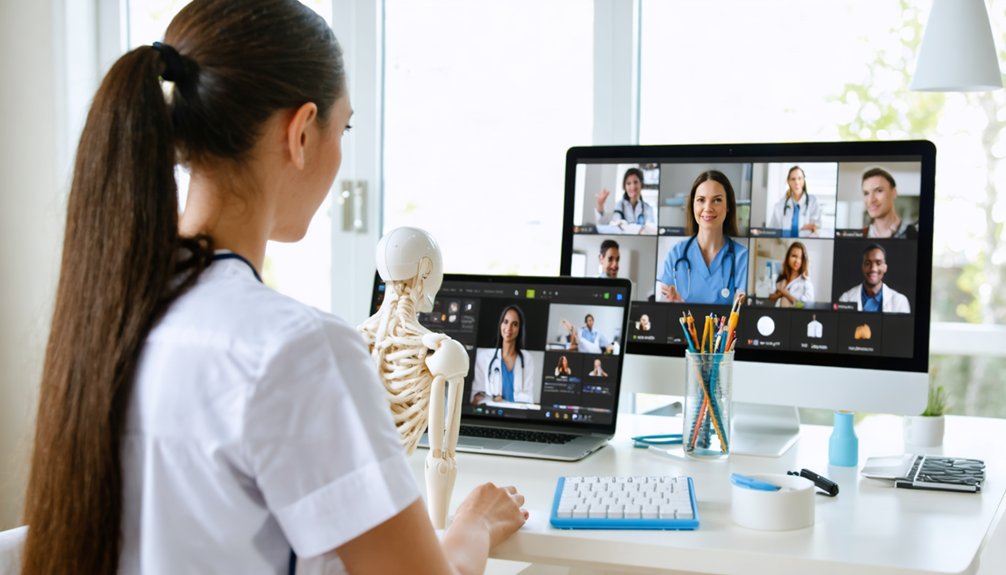

Online allied health programs usually teach clinical skills through a blend of virtual simulation, live instructor-led practice, and supervised externships. Students rehearse assessments, procedures, and decision-making with 3D anatomy tools, virtual patients, and weekly video coaching. Many programs then require short in-person labs or 8- to 12-week placements in clinics or hospitals. Certification prep, competency rubrics, and mentorship help strengthen confidence, technical accuracy, and job readiness. Program comparisons reveal important differences in structure.
How Online Allied Health Programs Teach Clinical Skills
Although clinical skill development traditionally depends on face-to-face instruction, online allied health programs now teach these competencies through a structured blend of interactive simulation, expert-guided instruction, and supervised practice.
Through 3D anatomy models, virtual laboratories, and live webinars, learners build anatomical understanding, rehearse procedures, and receive timely feedback from experienced faculty and peers. Many programs also use patient simulations to mirror virtual care encounters and strengthen clinical decision-making in realistic scenarios. Some programs also incorporate virtual physical exams demonstrated by experts to model evidence-based telemedicine assessment techniques.
Programs commonly deliver most theory online, then reinforce performance through short in-person labs and clinical externships. In many hybrid healthcare programs, students complete weekend lab training in 2–8 days of in-person sessions to practice essential clinical skills.
This sequence lets students enter supervised settings with stronger confidence and clearer expectations.
Progress is tracked through competency rubrics, standardized assessments, and supervisor review, helping programs confirm readiness in communication, technical execution, and telehealth-related tasks.
Interprofessional activities further strengthen teamwork, while continuous feedback supports improvement and helps each learner feel connected to a professional healthcare community.
Virtual Simulations That Mirror Real Patient Care
Because online learners still need repeated exposure to realistic patient encounters, virtual simulations have become a central tool for mirroring real clinical care without placing patients at risk.
Programs such as vSim for Nursing and Body Interact let students assess symptoms, monitor changing key signs, select interventions, and receive personalized feedback that strengthens clinical judgment. With a library of more than 1,200 cases, some platforms provide virtual patient scenarios across pre-hospital, emergency room, and consultation settings. Many programs also use realistic scenarios to support hands-on decision-making in safe online environments.
Evidence indicates virtual patients can outperform traditional instruction for skill development, with stronger results across multiple studies and positive effects in blended formats.
These platforms build confidence, procedural accuracy, and team-based decision-making while supporting knowledge gains comparable to conventional methods. Many educator-designed options are also available as open educational resources, making them free to use and adaptable across healthcare curricula.
Free and open resources also widen access, offering diverse cases in nursing, paramedicine, and triage.
Through Virtual Reality, Augmented Reality, and screen-based scenarios, online learners encounter inclusive, reflective practice environments that reinforce safe, effective patient care.
Live Virtual Sessions for Guided Practice
When clinical skills must be coached in real time, live virtual sessions give online allied health students direct, supervised practice that static coursework cannot provide.
In telehealth-focused courses, faculty often lead weekly two-hour Synchronous Discussions over seven weeks, using Zoom and similar platforms to coach interviewing, medication reconciliation, and other Telehealth Protocols.
Interactive coursework can reinforce these meetings through videos and simulations that let students review techniques between sessions.
Simulated service-users prompt proactive communication, while assessment tools such as supervisor rubrics and competence scales track progress objectively. Programs can further support readiness by combining supervised virtual practice with guaranteed externship placements that extend learning into real clinical environments.
Evidence indicates these sessions work best within hybrid designs that pair online instruction with selective face-to-face reinforcement.
Studies report targeted telehealth competencies, stronger attitudes toward virtual care, and better separation of video versus telephone skills for focused practice.
Interprofessional teamwork, guided modules, electronic health records, and accredited continuing education structures help students feel included in a professional clinical learning community. Humanitas Institute emphasizes immediately usable skills that students can apply on their next shift across clinical settings.
How Externships Add Hands-On Clinical Training
While online coursework can build foundational knowledge, externships supply the supervised patient contact and procedural repetition required for true clinical readiness.
Through Placement Partnerships with hospitals, clinics, and rehabilitation centers, programs place students in supervised rotations where they practice core tasks, document patient care, and build confidence within real care teams.
Hybrid models typically begin with asynchronous theory, then shift into 8- to 12-week externships shaped by state regulations and certification standards. These experiences are often guided by subject matter experts with hands-on and real-world healthcare experience.
Under preceptorship guidance, students perform duties such as EKGs, blood draws, and back-office medical assisting procedures while strengthening patient safety, emergency response, and clinical judgment.
Externship Logistics often include site selection by location, remote progress tracking, and evidence-based evaluations.
This structure helps learners feel connected to professional expectations and better prepared for nationally recognized allied health credentials.
Self-Paced Certifications With Clinical Exam Prep
For learners seeking flexibility without sacrificing rigor, self-paced allied health certification programs combine expert-led video instruction, eBooks, and competency assessments in a fully online format that can be completed in as little as 8 weeks or extended up to 12 months.
This Self Paced Flexibility supports varied schedules while keeping exam readiness central.
Many programs require only a high school diploma or GED and prepare learners for CMAA, CEHRS, CBCS, CPhT, CCMA, and CPCT credentials.
Clinical exam prep is structured through premium study guides, flashcards, Quizlet sets, timed quizzes, and authentic practice tests.
Unlimited practice exams with immediate scoring and one free retake strengthen readiness, while Certification Exam Fees are often included.
With customized registration support and a 92% pass rate, participants join a broad, credentialed allied health community.
Mentorship That Supports Clinical Confidence
Because clinical skill develops most reliably through guided practice, mentorship remains a core support in online allied health programs that aim to build clinical confidence alongside technical competence.
Evidence shows mentorship improves clinical-competence scores more than peer learning, with significant gains linked to personalized feedback, reflective observation, and secure supervision.
Effective programs emphasize Mentor Selection, often allowing learner self-selection to strengthen trust, engagement, and appreciation.
Mentors are expected to share knowledge, give step-by-step instruction, and provide real-time feedback during practicum experiences, simulations, and remote supervision.
Protected mentoring time further supports confidence, skill use, and professional identity formation.
Through Longitudinal Bonding, mentees experience consistent guidance that supports belonging, well-being, and career development.
These structured relationships also strengthen evidence-based practice use and help learners translate training into competent patient-centered performance.
How to Compare Online Allied Health Programs
When comparing online allied health programs, the most reliable starting point is accreditation, since it confirms that curriculum quality, faculty qualifications, and institutional policies meet established standards.
AccreditationStatus should include institutional approval from a U.S. Department of Education recognized agency and, when applicable, programmatic review such as ABHES.
Prospective students should also confirm state licensure or certification alignment, especially for out-of-state enrollment.
Next, programs are best evaluated by fit: degree options, concentrations, transfer credit policies, timeline, and format.
Applicants should compare whether coursework covers healthcare systems, ethics, sciences, communication, and professional development, while supporting manageable pacing through asynchronous or block structures.
AdmissionRequirements also matter.
Official transcripts, prerequisite coursework, related certificates, and state-specific availability can determine whether a student can enter and progress confidently.
References
- https://trainalliedhealth.org
- https://advclinical.org/blog/university-allied-health-education/
- https://www.humanitasinst.org/allied-health-courses
- https://learn.adclin.org
- https://alliedhealth.llu.edu/academics/online-courses-and-degrees
- https://alliedhealthed.com
- https://online.pennwest.edu/programs/allied-health/index.php
- https://www.telementalhealthtraining.com
- https://www.monroeu.edu/academics/undergraduate-programs/monroe-online/school-allied-health-professions
- https://advclinical.org/why-advanced-eclinical-training/online-medical-training-with-act/